Our NTP Infrastructure Since 2005
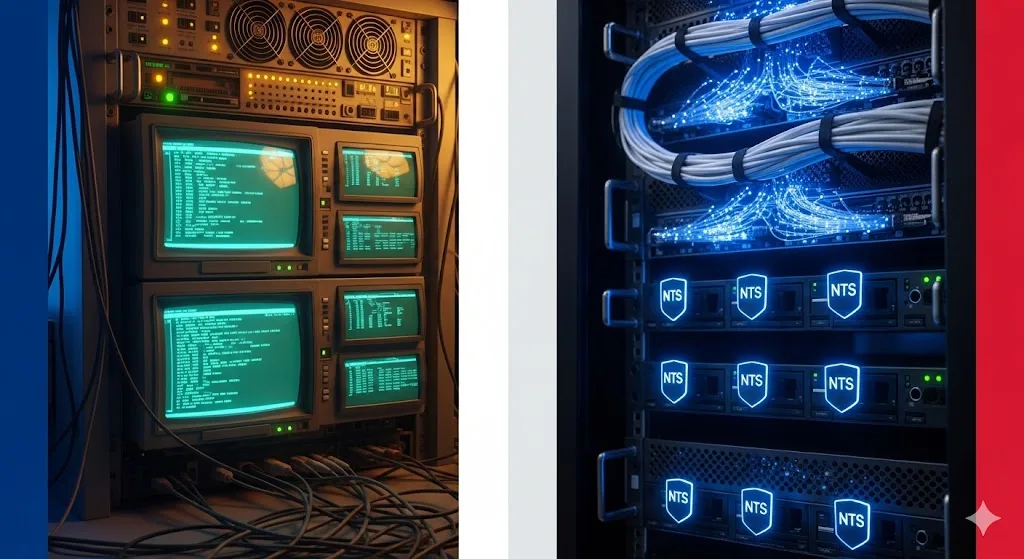
Timeline: from 2005 to today
Every step of this infrastructure has been driven by the same conviction: time synchronization is a public good of the Internet that deserves serious and lasting investment.
First NTP servers
Fresh out of university, the first NTP servers are put into service — including a server I managed for a friend's father. The goal is simple: contribute to the global NTP pool and participate in the community effort. At the time, it was driven by a thirst for learning and a certain vision of the Internet — you build, you share, you improve together.
First public traces
The contribution to the global NTP pool becomes publicly visible. The domain ntp.demongeot.biz is already online and referenced in Web archives.
Scaling up
Multiplication of servers in the pool. The infrastructure moves beyond a single server to become a coherent set of machines dedicated to time synchronization, spread across multiple points of presence.
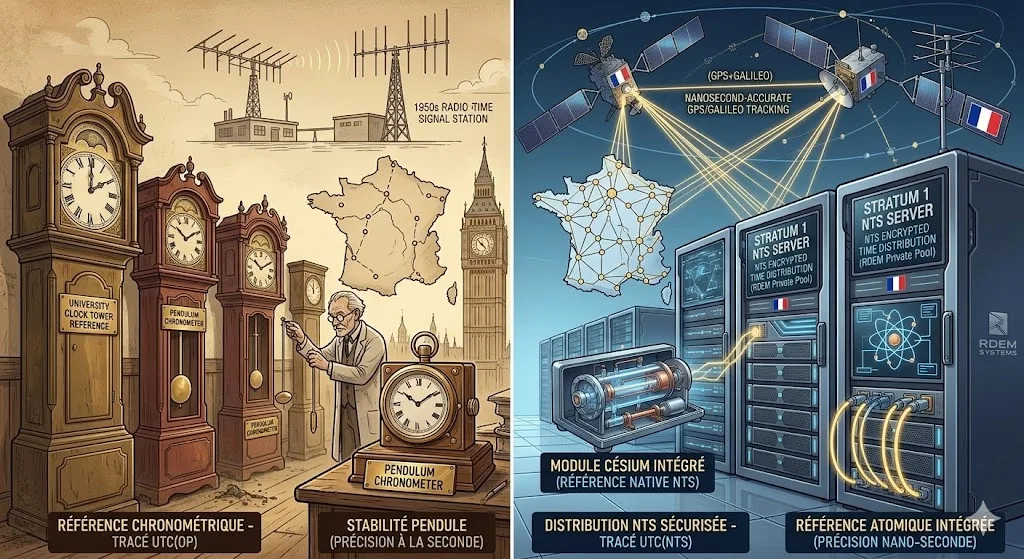
Upgrade to Stratum 1
Deployment of the first Stratum 1 server equipped with a GNSS receiver (GPS/Galileo) with PPS (Pulse Per Second) signal. The infrastructure moves from secondary synchronization (Stratum 2) to a direct time reference, with microsecond-level accuracy. Understand NTP stratum levels →
RDEM Systems SAS founded
Foundation of RDEM Systems. The NTP infrastructure, previously operated personally, begins its transition to a professional framework. The expertise accumulated over 11 years becomes a company asset.
AS206014, NTS and official transfer
A pivotal year. Acquisition and deployment of AS206014 — NTP servers are now operated on RDEM Systems' own network, with full control over routing, peering, and quality of service. Direct connection to Parisian IXPs.
Late 2025: activation of NTS (Network Time Security) across the entire infrastructure, systematic deployment of dual-stack IPv4/IPv6, support for 8 different TLDs for maximum DNS redundancy.
Official transfer of the entire historical NTP infrastructure to RDEM Systems. What was born as a volunteer contribution in 2005 is now a structured technical pillar of the company, with 20+ years of continuous operational experience.
Proof of history
In the NTP world, longevity is not just a matter of prestige. An operator who has maintained servers for over 20 years has weathered dozens of protocol updates, leap seconds, hardware failures, and network evolutions. This experience translates into proven reliability.
Current architecture
RDEM Systems' NTP infrastructure is built on a strict hierarchy, from the GNSS receiver to end clients:
Infrastructure components
- 1 Stratum 1 server: Raspberry Pi + GNSS receiver (GPS/Galileo) + PPS signal
- 16 Stratum 2 servers: ntp1 to ntp16.rdem-systems.com, in the global NTP pool — fourteen in France, two in Frankfurt
- Four independent sub-pools:
0.to3.ntp-pool.rdem-systems.com, four machines each. Every sub-pool carries four distinct autonomous systems, four distinct sites, and only one machine on the prefix we announce ourselves — should that announcement drop, no sub-pool would lose more than one machine in four. A client configures two of them and gets eight sources:chronydkeeps four perpooldirective. - Primary network AS206014: BGP routing, peering at Parisian IXPs — some servers also hosted on transit operator networks or rented machines
- Dual-stack IPv4/IPv6 on the 16 Stratum 2 servers; the Stratum 1 is IPv4-only and serves no NTS
- NTS (Network Time Security) enabled across the infrastructure
- 8 different TLDs for maximum DNS redundancy
- Equinix hosting in the Paris area, in our own racks
- 24/7 monitoring with automated alerts
Two structural choices are documented separately: the selection criteria for the Equinix datacenters (power, peering, neutrality) and the DNS resolution spread across four distinct ASNs in line with RFC 2182. The second protocol matters almost as much as the first: an NTP server you can no longer resolve is no longer reachable.
Infrastructure in numbers
Our philosophy
The same infrastructure also powers The Speaking Clock, our free phone-accessible talking clock service — a concrete consumer-facing example of what Stratum 1 NTP can deliver.
What started as a volunteer contribution has become, over time, a core technical asset. But the philosophy hasn't changed:
We don't sell NTP services. We operate a public infrastructure because we believe that time synchronization is a public good. The same conviction that drove the first server in 2005 guides our decisions today:
- Contributing to the NTP pool: our servers handle millions of daily requests for the community
- Maintaining reference quality: maximum reliability score, sub-millisecond accuracy
- Investing for the long term: 20+ years of continuous operation, and counting
- Sharing knowledge: technical documentation, guides, and experience reports
Going further
This infrastructure is documented across other, more technical pages that detail each of the components mentioned above:
- Enable NTS on Chrony in 5 minutes — the practical guide to the cryptographic layer deployed across our servers in late 2025.
- NTP stratum hierarchy — where our servers sit (Stratum 1 GPS, Stratum 2) and why this hierarchy matters in NTP.
- Sovereign NTP in France — the reasoning behind operating a time infrastructure from France, on AS206014.
- RDEM Speaking Clock by phone — the consumer-facing service powered by this same Stratum 1 reference.
- AS206014, our ASN — technical sheet of the network that hosts our NTP: peering, IPv4/IPv6, Parisian IXPs.
- Our NTP servers from the network side — AS, transit and site of each server.
- Our Equinix datacenters (PA3, PA4, PA5)
- BGP Looking-glass — public tool to observe live the routing of our prefixes from various network vantage points.
- UTC time traceability audit — the compliance offering (MiFID II, DORA, NIS2) built on this infrastructure: the dossier that proves your clocks are traceable to UTC.
Free NTP Tools
Three independent tools to diagnose your time synchronization: