The Speaking Clock
The 21st-century talking clock, heir to a French tradition since 1933
* Cost of a local call from France
Rather read it than hear it? See the exact time on screen, corrected for your clock's offset.
A French tradition since 1933
The history of the speaking clock in France
The speaking clock is a French institution. Invented by astronomer Ernest Esclangon, director of the Paris Observatory, it was inaugurated on 14 February 1933 and immediately became an iconic public service.
Sources: Paris Observatory and SYRTE press release on the end of 3699 (3 May 2022, PDF, in French) · Next: the talking clock gives way to heurelegalefrancaise.fr (in French)
Modern technology in the service of precision
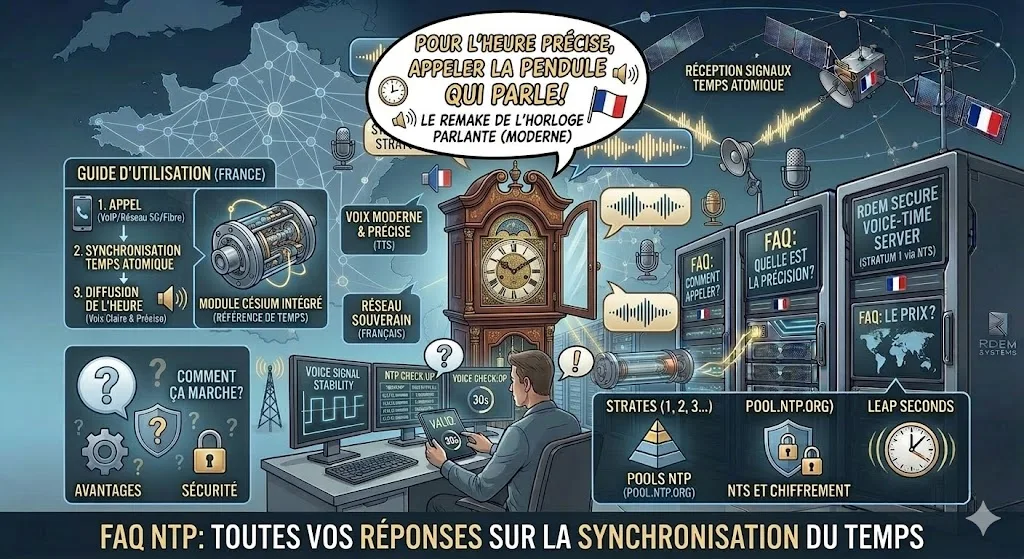
The Speaking Clock is not just a nostalgic tribute: it is a cutting-edge technical service built on both our expertise in time synchronization and our experience in voice over IP.
NTP synchronization
The Asterisk server, like our web server, synchronizes over NTS with our Stratum 2 servers, which follow public Stratum 1 servers: it is therefore at Stratum 3 (reading of 15 October 2026). The time shown on this page is your device's, corrected by its measured offset from our web server.
Tom Voice (Piper TTS)
High-quality French speech synthesis, generated locally for minimal latency.
SIP Telephony
Professional Asterisk infrastructure with SIP trunk provided by IPPI.com for maximum availability.
To the second
The beep is aligned on an NTP-synchronized clock; on the phone, it is the voice's journey that limits precision, not the clock.
How it works: the infrastructure behind the voice
The Speaking Clock is powered by the same infrastructure that synchronizes thousands of servers around the world via the NTP Pool. To measure live the offset between your machine clock and our reference, the ntp-tester.eu live tool displays it second by second.
Three dedicated pages detail the technical chain that, at the other end of the phone line, delivers a voice announcement aligned on a synchronized clock:
- The operator's history and architecture: Our NTP infrastructure since 2005 — 20+ years of operation, from the first volunteer server to today's 16 NTS servers and our GPS Stratum 1.
- The layer that authenticates our NTP servers: Source of time: NTS on Chrony — the cryptographic layer that authenticates upstream NTP servers.
- What "Stratum 1" and "Stratum 2" mean: NTP stratum hierarchy — how each level of the hierarchy maps to the accuracy reachable at that tier.
Stratum 1 & 2 Servers
Raspberry Pi + GPS
Secure synchronization
Acknowledgements
Guillaume for coming up with the name "La Pendule qui Parle" (The Speaking Clock).
IPPI.com for providing the SIP trunk and French phone number.
Free NTP Tools
Three independent tools to diagnose your time synchronization: